How The “Renegade” Sparked Criticism Over TikTok Originality

The newest social media app craze, TikTok, has taken over the social spectrum. People ages 7 to about 25 create their own original videos to post in hopes of impressing their followers and potentially making it on the “For You Page” and going viral. Now, although all content that is posted but be original (as in there is no retweeting, sharing, or timeline aspect of the app), many of the videos are dances, like the renegade, that are made up by a single person. 

Taking a look at these, we can see a clear example of cultural transmission that we recently learned about. The definition of cultural transmission as given in the lecture slides is, “The process through which digital content moves from one person or a group of people to another, sometimes changing in the process”. 

TikTok star Charli D’Amelio often uses her platform to show herself recreating these dances. As the video trickles to her 30 million followers who send it to their friends, like the video or post it on Twitter, it begins to gain popularity. Many users even find themselves recreating the dances. See how the chain works? As with a game of telephone, the dances get modified through transmission. Dances get personalized and moves get changed. Users often add their own twist to the dance or just simply have fun with it and unfortunately the one who creates the dance often gets none of the credit. 

The viral effect becomes clear at the expense of giving “original credit”. Recently as we saw in the news, the moves of the Renegade were NOT created by Charli D’Amelio as most had presumed, but instead by 14-year-old Georgia teen Jalaiah Harmon. Charli performed the dance which went viral but failed to ever give credit to Jalaiah. After some social media searching, Charli was alerted to this and the two eventually met up and performed it together. A nice tribute for the most popular TikTok dance. Charli received some backlash but after tracking down Jalaiah, she redeemed herself in the world of social media and now tries to always credit the “TikTok choreographer”.
Meta-Critique of the Academy Awards

From audience reactions to surprise guests and even bathroom exchanges, the New York Times took a deeper dive into criticism of this year’s Oscars, going beyond just the winners and losers. The message of this article was clear: to evaluate all of the elements that go into the Oscars, defining the best and worst moments. Knowing that the only way people could view the Oscars was from a broadcast service, the critics talked a lot about what was actually shown on screen rather than make general conclusions. In two seperate sections they gave credit to “best reaction shots” from audience members caught with an absurd face during Eminem’s performance. They also criticize camera shots on introduction and nominee announcements. I would also say that the critic takes into account societal constraints when reviewing the Oscars, shedding light on some topics that were within the public interest enticing readers to continue to digest their critique. 

In chapter 3, Orlik states that ‘receiver criticism tends to focus on the effect that the originator’s medium-conveyed message has on the audience’. By analyzing reception theory through knowledge, group identification and receptivity, we can ascertain whether or not the NYT succeeded in their message. In terms of knowledge, we can assume that anyone reading an article about best/worst elements of the Oscars has some background information about what it is and some, if not most, of the current players in the entertainment industry. NYT was writing for a group that is familiar with this industry, therefore explaining why aspects such as red carpet looks, production choices and surprise guests were important to rank. These media critics know they cannot force audience agreement but can hope to use their platform and opinions to shape public perception. The originator in this case consists of all of the NYT writers who publicized their opinions in contribution. They selected and shaped the article to be a reflection based on what they deemed to be important moments. The intent through this whole article stays the same, to give opinions on the best and worst moments of the 2020 Oscars.

#BroomChallenge

People took to all forms of social media to take part in the #broomchallenge on February 10th. Apparently NASA released a statement that claimed that because of the moon and gravitational pull, household brooms would stand up on their own today. Although the original statement from NASA has not been located, people took to social media posting videos all across TikTok, Instagram stories, Facebook and Snapchat Stories. The hashtags #BroomChallenge and #NASA were trending on Twitter all day with tens of thousands of tweets for each phrase. 

This challenge went viral for many reasons but we can take a closer look at the STEPPS theory to understand why. The social currency behind this challenge was that you were a part of a special phenomenon and “hip” enough to have participated in it, posting a reaction video or picture it to friends and family. A trigger for this was taking to Twitter and using the hashtags that went along with it. Thanks to the hashtags and so called “announcement” from NASA, many people will most likely associate this challenge when thinking about NASA now as a “remember when?” sort of thing. 

With any sort of challenge the emotion behind it draws people to participate. In the case of the broom challenge, it was joy and shock that came when it actually worked. But of course with this, who just takes the video to keep for themselves? Anyone who participated took to social media to share their reaction and success OR fail publicly, using social proof to prove that it either worked (in most cases) or didn’t. There was not much practical value in this challenge besides the fact that some people may have been more inclined to read up on the moon and its effect on gravity, causing the broom to do what apparently it can only do today.

It will be interesting to see what type of stories come out in the next week from this challenge. My prediction is that sales of popular broom brands will rise and Google searches for NASA will increase.

In my own findings, people began to take the challenge to another level and make jokes about this challenge, doing headstands saying “its works on humans too”, and photos of eggs balancing with the same sort of caption.

Now whether this challenge is a hoax and household broom stands up on its own everyday, is something we won’t know until the morning. But what we know for sure is that on February 10th, people were pulling their brooms out of their closets and standing them up… some hopefully going the step further and actually using it to tidy up.

Role of the Media Critic

*Response based on the HighSnobiety article about Super Bowl Halftime Shows*

Although this article was an opinion piece on the best and worst Super Bowl commercials of the 2000’s, author Jake Indiana served as a connector between creator and consumer. He used the bridge building tactic to provide the audience with quick recaps of each performance, why he chose to rank them a certain way and a video of each performance. He took public opinion into consideration while also forming his own list ranking bad to good. He created an ease of access for the readers to take his opinion into consideration, given all of the details of the performance. 

Jake Indiana suggested new directions (also known as practicing “creative criticism”) many times in which he proposed that certain artists who he ranked low were out of touch with the trends/social themes at the time of their performance. He makes certain suggestions like changing a certain line up, choosing a different song or using different props that could’ve made the performance more successful. 

Proposing system-cognizant change was evident in this article. In this manner he was not just discussing the performers song and outfit choice, but speaking about how the game itself was a key player to the exposure of the Halftime Show that year. Modification to the “system”, in this case Super Bowl as a whole, such as a change in stadium location, which teams were competing and pre-game “hype”, would have an effect on how the Halftime Show is received and viewership numbers. 

Jake Indiana is a music editor which puts him at an advantage to be well-respected in his opinions. He serves as a proxy or watch dog, writing about two posts per week for HighSnobiety. His expertise as a media critic positions him as a trusted source for the public. Criticism must be expressed in a manner that is entertaining and fun to read. Jake Indiana is successful in this as he often uses slang terms relevant to the current time and even proposes rhetorical questions to prove his ranking reasons. His style/tone of writing is casual yet informational, often times reminiscing on the artist’s “prime”. 

Digital Media Usage

Interpreting EveryDay Media Use

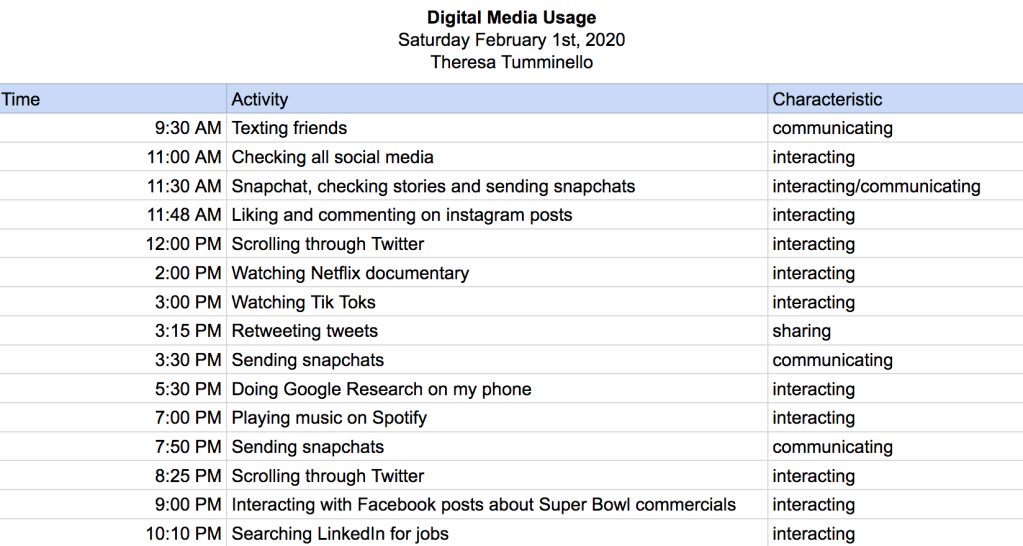
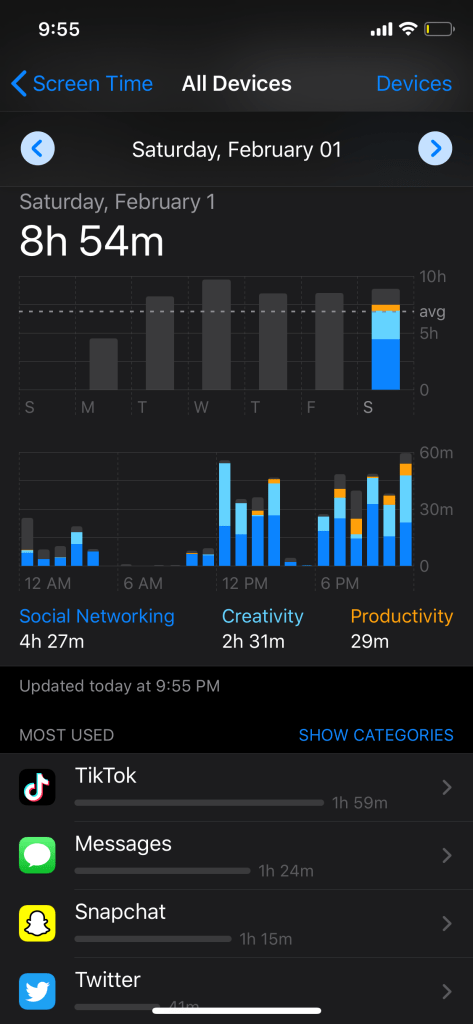
After looking into my media usage on Saturday, not only was I a bit alarmed by the total number of hours I spent on my phone that day, but I found it interesting to analyze which apps and programs that I spent the most time on. I think that most of us don’t realize that the total time spent adds up over the entire day. I personally had 162 pickups throughout the day, with a total screen time of 8 hours and 54 minutes. I specifically picked Saturday to look into my usage because I knew that I had no plans and thought it would be interesting to see how I used my “free” time. 

When breaking down each category into the four characteristics, I found that I spent the most time interacting. Some of the apps give their user a choice of whether they want to interact or communicate or do both. I found that I used Snapchat and Twitter for more than one function. Even though I was interacting with my “friends” by scrolling through my timeline watching snapchat stories, I was also communicating with individual friends by sending them personal snapchats having a conversation and sending certain friends tweets that I thought were funny. 

I wasn’t too surprised that my most common characteristic was interacting. I like to sit back and observe, so I tend to spend most of my digital time just scrolling and staying on top of current social trends as well as keeping up with current events. In interpreting my data, I can say that I lean towards digital content on the most popular social media apps. Although I did watch Netflix for a short time, I spent the majority of my time reading/watching content that is produced by others. I personalize each of my social media channels to follow who I want and what topics I want to keep up with, which could explain why I spend hours per day on each channel because I enjoy what is presented to me.

Design a site like this with WordPress.com
Get started