Featured

Digital Media Usage

Interpreting EveryDay Media Use

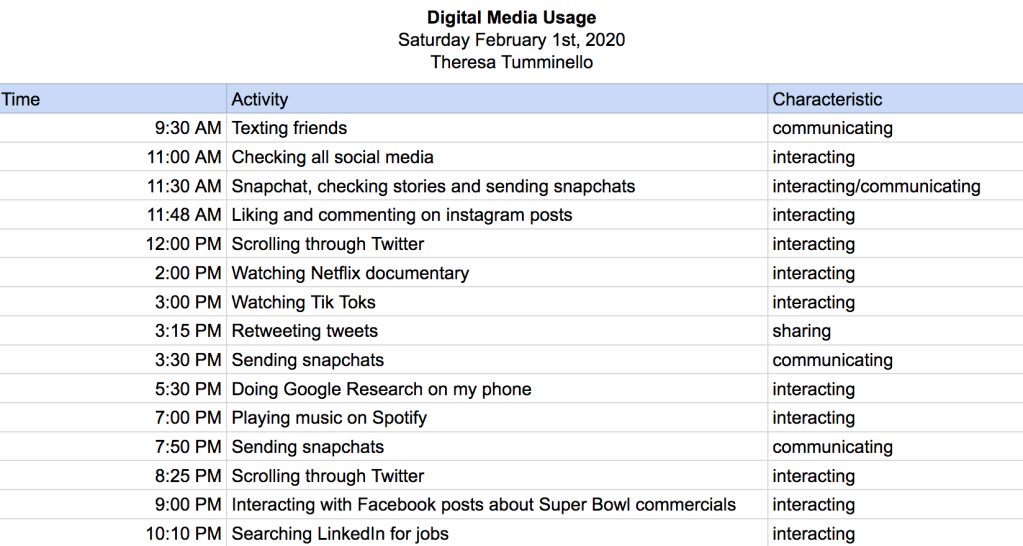
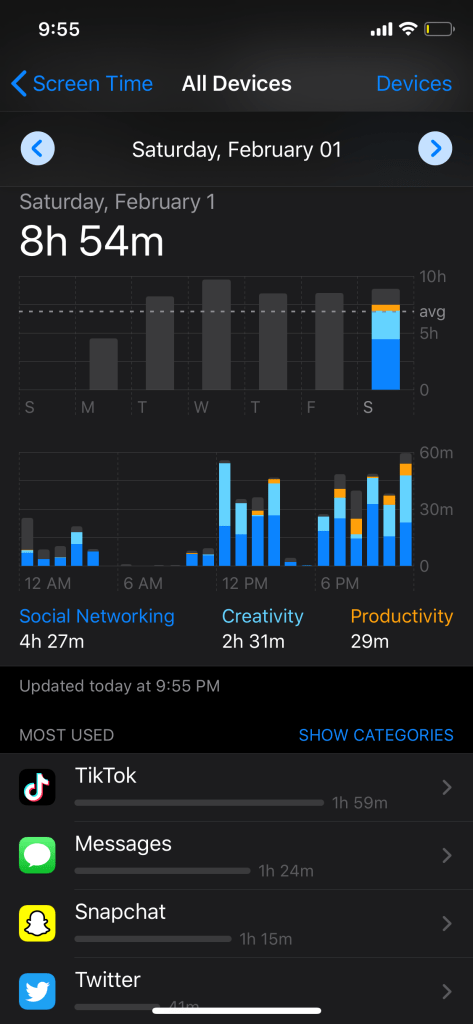
After looking into my media usage on Saturday, not only was I a bit alarmed by the total number of hours I spent on my phone that day, but I found it interesting to analyze which apps and programs that I spent the most time on. I think that most of us don’t realize that the total time spent adds up over the entire day. I personally had 162 pickups throughout the day, with a total screen time of 8 hours and 54 minutes. I specifically picked Saturday to look into my usage because I knew that I had no plans and thought it would be interesting to see how I used my “free” time. 

When breaking down each category into the four characteristics, I found that I spent the most time interacting. Some of the apps give their user a choice of whether they want to interact or communicate or do both. I found that I used Snapchat and Twitter for more than one function. Even though I was interacting with my “friends” by scrolling through my timeline watching snapchat stories, I was also communicating with individual friends by sending them personal snapchats having a conversation and sending certain friends tweets that I thought were funny. 

I wasn’t too surprised that my most common characteristic was interacting. I like to sit back and observe, so I tend to spend most of my digital time just scrolling and staying on top of current social trends as well as keeping up with current events. In interpreting my data, I can say that I lean towards digital content on the most popular social media apps. Although I did watch Netflix for a short time, I spent the majority of my time reading/watching content that is produced by others. I personalize each of my social media channels to follow who I want and what topics I want to keep up with, which could explain why I spend hours per day on each channel because I enjoy what is presented to me.
Modern Family and Composite Criticism

When analyzing a program’s approach, looking at composite criticism can help put the show in an accurate and realistic perspective for both critics and audiences.

Within intrinsic evaluation we can see that Modern Family has evolved the sitcom genre as a whole. The family dynamic was progressive as they were blended, wealthy and extremely diverse. The show was the first of its kind to publicly display recurring trends like marriage equality when they showed Cam and his partner Michtell getting married in season 5 and Latino stereotypes. The show took on a mockumentary style, like “The Office”, and normalized unusual happenings as comedic relief, paving the way for newer sitcoms like “Two Broke Girls” that test boundaries of contemporary storylines.

Although the finale episode of the series aired recently on April 8th, the series was extremely successful throughout its 11 seasons, winning 22 Emmys. Some of the jokes, stereotypes and values portrayed in the series may not have always aligned with the audience’s morals but intrinsic appreciation is clear when recognizing the huge success that the show achieved. 

Extrinsic appreciation was achieved as the creators and producers adapted to difficulties and major events in real-life society. The show stayed up to date with the social, technological and societal trends that changed over the 11 years. Even down to the small elements like upgrading the characters phones as society switched from flip phones to smartphones. For example, in season 6, episode 16, Claire relies on Facetime as she waits for her flight to get the rest of the family to look for Haley. Most of the episode is filmed as if the family is on Facetime with each other. With this episode, Modern Family adhered to social trends as they normalized texting and facetiming as adequate forms of communication with family. 

Modern Family’s effect on its audience generates a contemporary resonance as extrinsic evaluation should. The consistent emphasis of irregular stereotypes and dynamics created a long-term exposure that inturn resulted in changes in social reality. It stayed timely and exposed some of America’s most overlooked faults.

Modern Family and The Logic Of Aesthetic Form

Modern Family is an American television mockumentary family sitcom. The series follows 3 different, but related families through everyday adventures. Every 22 minute episode jumps back and forth between the three families and intertwines their daily activities together. The show is flooded with controversial themes about what it means to be a family in modern society. 

One reason that Modern Family as a series was so successful was because they reinforced themes of family roles, cultural stereotypes and homosexual stereotypes throughout all 11 seasons. As characters aged and relationships changed, these themes stayed consistent, usually teaching new lessons at the end of every episode. Contrary to mainstream values or the consensus narrative, Modern Family pushed the boundaries of controversial themes.With the recurring challenging themes that Modern Family tackles, they begin to become normalized. 

The balance element is clear in each family with the clear distinction between each couple. Take Jay and Gloria for example. Jay is a traditional middle aged man who is the head of his family and takes this role very seriously. He is often strict and unwilling to change his traditional no nonsense ways. His wife, Gloria on the other hand is a fiesty, fun loving housewife who is more than 20 years younger than her husband. Her cultural barrier creates tension within the household and between other family members. Despite these “challenges” Gloria is accepted into the family and often coached on American traditions, while Jay is encouraged to ease up and have fun in life. The two show that opposites can attract and make a successful marriage. 

In season 10 of Modern Family we begin to see evolution when the reckless daughter, Haley, gets pregnant. Within one short season, Haley transitioned from a free spirited, party girl to a mother at a young age in unplanned circumstances. The show contains hierarchical elements in stereotyping certain elements. While the show aims to bring light to common stereotypes of the different themes presented, it also uses humor when the characters make fun of their own stereotypes. 

The irregularity of Modern Family is what makes the show a comedic masterpiece.

Showing Off Culture Through Viral Tik Tok Challenges

Over the last few weeks I have noticed that many people have been trying to find new ways to occupy their time and most have turned to social media apps to pass time while the COVID-19 Stay At Home order is in effect. In my own scrolling on my rotation of social media apps, I have noticed the increase in “challenges”. One that struck my attention and had me scrolling for more than normal was a special dance to show off a user’s culture. With the use of a certain song, the challenge is to change outfits each time the verse is repeated, and because it is Tik Tok, there are a few dance moves involved as well. Take user, “Jazlynebaybee”, for example. Her video of her and her partner’s Hawaiian and Korean culture appreciation earned her 5.6 million likes and over 66 million views. This trend quickly caught on and I began to see my feed flooded with TikTokers participating in this challenge. These online, viral challenges, are what is keeping us connected. 

As we look at what is next for culture in terms of virality, I think we will see more people participate in showing off their culture on social media. Sharing content helps define and refine culture. Not only does it advocate for cultural norms, but it spreads awareness about cultural trends that many may not be aware of. These challenges go hand in hand with the STEPPS factors of virality. As users participate in this viral cultural challenge, they have the feeling of uniqueness as they represent their own culture but also inclusiveness as they find their way to stay connected and relevant during the Coronavirus.

Structural Analysis

Criminal Minds is a well-known television show aired on CBS since 2005. The television show is wrapping up it’s 15th and final season later this month. The show follows a team of F.B.I. Behavioral Analysis profilers who are out to find some of the most dangerous serial killers and criminals by reading into their motives and minds. The show is unique in it’s own way because although the team of profilers stays the same, the crime that they are looking to solve changes every episode. 

Criminal Minds combines the concept of murder and danger (antithesis) with heroism and bravery (thesis). While we watch the lesson of friendships between the team members, viewers can often see betrayal when a murderer kills his family – all in the same 40 minute episode. The two concepts are merged to create a greater meaning (synthesis). The combination of the anthesis and the synthesis of good and bad and the actions of heroism when the team of profilers finds the suspect, can leave the viewers not only satisfied but feeling comfortable. The two components work together because if there was no “unsub” (unidentified suspect) there would be no fear, but if the F.B.I.team did not work around the clock to solve the crime, there would be no heroism. 

What comes from this synthesis is many feelings of emotion including fear and uncertainty. Many reviews state that the show is “too scary” or viewers advise others “not to watch at night”. But with the ending of every episode, the suspect is found. The F.B.I.team prevails and although sometimes not in time, the “bad guy” is always taken away to be of no more harm to society. In the end, the “good guy” ultimately wins. This gives viewers a sense of comfort, knowing that although the show may not be based on true events, the F.B.I. is a real government unit and unfortunately they do deal with criminal activity often. They can attribute the storyline of the Criminal Minds, to the security of knowing there is a team out there in real-life doing the same.

Vanessa Hudgens and Cancelled Culture

In this week’s lecture we learned about the ethics of virality. Within this section were topics such as Cancel Culture and Call Out Culture. It seems that in today’s social media society there is a new celebrity being “cancelled” every other day. Most times on Twitter you’ll find a trending hashtag with #(celebrity name)cancelled. 

The latest celebrity to fall victim to Cancel Culture was Vanessa Hudgens. In an Instagram live video on March 16th she voiced her opinion about the Coronavirus social-distancing regulations and had made the comment “Um, yeah, ’til July sounds like a bunch of bulls—. I’m sorry. It’s a virus, I get it. Like, I respect it. But at the same time, like, even if everybody gets it, like, yeah, people are gonna die, which is terrible but, like, inevitable?”.

Fans, followers and the public took to Twitter to “cancel” Hudgens using the hashtag #VanessaHudgensIsOverParty. She was referred to as being “cancelled” and slandered for her simple-minded comments regarding the Covid-19 crisis. She was publicly shamed on social media so badly that by the next day she issued a statement on Twitter apologizing for her insensitive comments. Hudgens turned off all Instagram comments on her posts because the public was calling her out on any outlet that they could. The speed of this viral movement compromised her career and public image in a matter of hours. 

She sure was held accountable for her comments as people are still talking about the incident one month later. Her comments on her Instagram posts were only turned back on 3 days ago and since the incident, she has advocated for Stay Home measures encouraging her followers and the public to stay isolated while this virus runs its course. Her instagram bio currently reads “STAY IN!! Don’t go out. Let’s get thru this together”.

Depiction Analysis

My dad was Deputy Chief of the West Orange Fire Department where he worked for almost 27 years before retiring. With that being said, he has made his way up the ranks and has seen some of the best and worst within a fire department. In the particular form of media, television, firemen are depicted inaccurately on the show Chicago Fire. 

In television shows like Chicago Fire, the cultivation effect comes into play. I remember watching the show with my dad a few times and I found myself asking him often “does that actually happen” to which he almost always answered no. As a child of a career fireman, I even found myself getting sucked into the theory of perceiving the real world to be similar to that of television.

The five questions asked in depiction analysis help understand what message is intended to the media’s viewers. In addressing a few of Orlik’s questions in relation to Chicago Fire and real-world firefighters, we can look at “Sexual Consequences” and “What Are Our Responsibilities”.

The sexuality in the workplace displayed by the characters in Chicago Fire is unrealistic and misleading. There are virtually no consequences for any of the characters actions when in reality some of the sexual activity that goes on in the station would lead to being fired in real life. 

I do have to argue that although dramatized, when the firefighters of Chicago Fire are out on calls, most depictions are true. The series tackles the responsibilities question pretty well. It’s shown not by what the characters say but by what they do. Fires may not be as dramatic as the ones on TV but when an alarm sounds in the firehouse, the men/women grab their gear, hop on the truck and go out risking their lives to save whatever/whoever may be inside the burning building. The book states that certain role model occupations must fulfill their duties and Chicago Fire is sure to work in the physical occupation aspects of firefighting.

Granted, television producer’s main goal is to make money, so they must make dramatic storylines between the characters with climactic plots. That just makes for good television. 

User Gratification

Almost all users of social media can be classified as prosumers, meaning people who both consume and produce media. As the global pandemic of Covid-19 continues to grow rapidly, I find my own screen time growing rapidly as well. I scroll through my own Twitter, Facebook, Instagram and LinkedIn for hours each day not only to keep up with the Coronavirus updates, but also to stay entertained. Media plays many roles in user gratification and in the time of national emergency including entertainment, information, escapism, companionship, problem solving, personal enrichment and/or tension release.

In a form of escapism from the gruesome reality of Covid-19, I have found myself slightly obsessed with the newest Netflix craze, “Tiger King”. The documentary series is a mess of muder, chaos and big cats. It seems that I am not alone in this obsession though. Besides Covid-19, “Tiger King” is probably the second most widely covered topic. Not only have I been binge watching episodes, but I find myself giggling at memes about the main characters Joe Exotic and Carol Baskin. This allows me to receive user gratification as well in the form of social bonding and entertainment. It is mindless comedy that lets me withdraw from the depressing news of Covid-19. 

Another trend I have seen become popular is the creation of TikTok videos. TikTok started as an app for young to middle aged children and was seen as childish by young adults my age. Ever since the Covid-19 outbreak and the increase of boredom, people ages 18-25 have “given in” and taken an interest in TikTok, myself being one of them. I personally have created three TikToks that are relevant to the current Coronavirus topic (which I am withholding to save my own embarrassment). For me, watching others and creating my own funny TikToks about how my senior year came crashing down and how isolation is driving me mentally insane is a form of catharsis and tension release.  

Through gratification and pastimes of media (and of course by staying home) we will find a way to get through this Covid-19 pandemic.

Slacktivism In This Covid-19 Pandemic

The Coronavirus has taken over almost every aspect of life including taking the social spotlight. The pandemic has had an effect on everyone across the globe but for seniors in college, like me, it hits a little closer to come. After our discussion of slacktivism vs. activism this past week, I have spent some of much free time trying to analyze action on my own social media feeds. 

I have found there has been a high volume of change.org petitions going around Facebook regarding university’s decisions on closing, refunds and graduations. From our own Montclair State, to Penn State University, East Stroudsburg University, TCNJ, and so many more, students from colleges big and small are sharing petitions, hoping to get signatures and encourage change from university officials. 

When first looking into these petitions, I thought they would classify as activism because most petitions were successful and granted student wishes. After reviewing class notes, I found that it fits into a bit of both categories but I feel that this specific spark for change is more related to slacktivism.

Change.org has very low barriers for entry meaning pretty much anyone who sees the petition can sign it. It is also very easy to participate, most petitions only ask for a name and email, and then your signature is added to thousands of others fighting for the same cause. With the above circumstances and the main way of access being Facebook, most times after being signed the user will also share the post, making it very easy to publicize and extremely viral. 

Although not much effort is required, it seems that little effort is all it takes now-a-days to result in change. Now although this may be circumstantial, in this worldwide emergency, the small actions people are taking works, which is why I classify it as slacktivism. Many social campaigns surrounding Covid-19 are a prime example of “Up the Ladder of Engagement”, a one step at a time movement towards change. 

Podcast Shuffle

I’ve listened to a few podcast series before, but in analyzing one in a critical way, I choose one that I was not biased to or familiar with. I chose to listen to the first podcast in a series called “The Officer’s Wife”. This series is under the True Crime genre is based on a story where a police officer’s wife is found shot to death in their home. Throughout the entire podcast, various guests speak about the red flags and previous suspicions they had about the husband. Although the story is from 2016, the first podcast was uploaded on January 13, 2020 and there have been 6 more added to the series since. Each episode is around 30 minutes long. Being that it is only available on Spotify, there was no public information about followers or rating.

The first episode starts with a warning to listeners, then a live recording from a 911 call center and the narrator setting the scene. The recording goes back and forth between the husband, the 911 call receiver and the police officer responding. It is interrupted every few seconds by the narrator setting the scene and giving information.The scene is set both verbally and musically as “dramatic” to catch the listeners attention right away. Dramatic music is played throughout the whole story, rising in volume as the guests recall their stories. 

The narrator’s voice was almost perfectly clear with no background interference whereas the sound clips from loved ones were met with static and distance. By going back to the narrator time and time again, the listener begins to trust that he has control over the story. The audio transitions and fades of the light high-pitched instruments keep the aesthetic of the crime-based theme. The production ingredient allows the listener to know when an key element is going to be uncovered when the music’s volume increases. 

All in all, “The Officer’s Wife” stays true to the elements that make it resemble a crime documentary. It used real life recording and dramatic elements to tell the story in an intriguing, successful way.

Design a site like this with WordPress.com
Get started